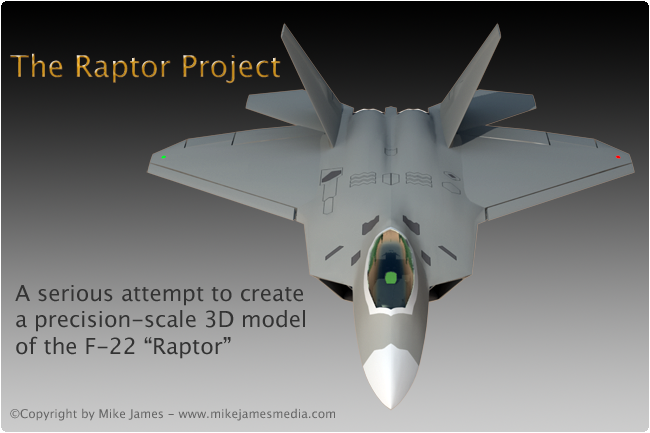
A serious attempt at a detailed, scale, 3-dimensional F-22 "Raptor"
Separate from the research, which I've been accumulating for several years, the actual 3D/CAD project began in June of 2008. It will be ongoing from there, for 6 months to a year. If you'd like to follow the progress of the model, welcome!
IMPORTANT: PLEASE READ THIS BEFORE EMAILING ME.
The 3D modeling of this aircraft takes a LOT of my time, so before emailing me, please have a look at these items, ok?
- RESEARCH: I have no more access to on this aircraft than any normal civilian. Today, nearly all the research material I've accumulated, aside from photos, has been done via the internet. I'm a happy and loyal U.S. citizen, and therefore, I won't be redistributing any documentation to anyone, even if it's public. I don't have time to do it, and it's not mine to redistribute anyway, so please don't ask for that. If you want to document the aircraft yourself, the fastest way is simply to search "lockheed-martin f-22" on Google. If you take the time, as I did, you can find every bit of documentation that I did, on your own. My research came primarily from Lockheed-Martin, the USAF, and various aviation enthusiast sites, where I found more air show photos.
- QUESTIONS: For the reasons above, there is a huge amount of speculation on various details of the aircraft. My interest here is primarily the accuracy of the exterior of the 3D model, so please don't ask me questions like "what is that access door for", or "what is that bump on the tail for", etc.. Chances are that I don't know, and there are various forums around the net to discuss those things, if you like. Try this forum, for example.
- ACCURACY: Since this is a new and operational military aircraft, there are security concerns that result in the fact that NO ONE will be receiving completely accurate documentation on it. So, while there are a variety of drawings and general arrangement views of this aircraft available, we must all take them with a grain of salt, and use photos and our eyes to zero in on some details. Everything I have done and will do, related to this model, uses the versions of this information that I THINK are the most accurate, along with my eyes, connected to my brain.
- The 3D model will eventually be for sale, but not until at least early 2009. I work long hours on these things, but it's a personal project, and so I'm not on a schedule or deadline of any kind. Sometimes there will be frequent updates, but there may be pauses in this work, too.
- RAMBLING: I'm not just "demonstrating an F-22 model" here. This is a tutorial for 3D modelers to illustrate methods, so it's a means of sharing information with everybody. I'll often interrupt the "F-22 stuff" to discuss methods. Sorry, if it seems distracting, but that's the price you pay for reading articles written by people like me.
Thank you!
- Mike James
An overview of the F-22
The aircraft itself is just the tip of the tech iceberg...
When a team like Lockheed-Martin, Boeing, or NASA design a new product, they often begin, knowing that they'll be using materials and methods that haven't been invented at the time they start. I've followed this aircraft's development since the early 1990s, when it was the YF-22, and have seen some impressive developments surrounding it.
These developments go far beyond the F-22 itself, and I'll point out some of the positive results of technological advancement, which often happen when you have both the Military and NASA researching the issues. Many of these advancements are operational today, in the F-22 and elsewhere, and I'm not just talking about weapons.
Lockheed-Martin's F-22 "Raptor" is the most advanced and capable 5th generation jet fighter on the planet. Once you begin to understand it's capabilities, and the discoveries that it's been part of, you may be surprised. Regardless, I'm an avid aviation fan and designer, and this project is not about politics. To me, It's a hugely-interesting and challenging project, made more difficult by it's very nature.. military, stealthy, etc. Phrases like "Total air dominance" are often used to describe it. Inside, (the things we aren't able to see) there are hugely-powerful electronic tools to enable this plane to be both lethal and invisible. It can fly very fast, very high, very slow and very low. If you get a chance to see this aircraft at an air show, go and be amazed.
There are quite a few videos of the flight demo on http://www.youtube.com. Just do a search for "f-22". It's ironic to me that the things you'll see in the flight demo are probably not going to be required of the F-22 in actual combat, since I believe it's primary mission will be high-altitude, stealthy operations. But, the air war in Vietnam taught us that it's best to be prepared for close-in fighting, and that's the kind of thing you'll see at the relatively low-speed air show demo. And of course, any mission can change at any time.
This aircraft is the very-public proof of some technology we've heard about for many years.
And... The benefits go well beyond combat scenarios.
I was born in 1954. When I grew up, (without the internet) electronics were generally thought of as fragile and unreliable. Take a look around you today, and every kid has a laptop, iPod, cell phone, PDA, MP3 player, and other gadgets. (Falling into a rain puddle can be an expensive mistake!) Combat-level military (and NASA) electronics aren't nearly as fragile, and are a LOT faster. As one example, a solid state "disk drive" can take a LOT more heat and cold, a LOT of G's, (acceleration and impact) and are a LOT faster. We're just starting to see them at reasonable consumer products, and it's one of the last moving parts in a computer that we can finally do away with, for greater reliability.
Of course, the same is true of design and manufacturing in general. We have a LOT more data these days, thanks to many years of advanced studies by NASA and others. Until computers became faster though, it wasn't easy to actually USE all that data. Now, the relevant aerodynamic, hydrodynamic, and other data can be in the designer's database, and correlated according to their needs, in near real time. Thanks to 3D modeling and CAD, we are nearly eliminating "prototypes", because the simulations are so accurate that less physical testing is required. This is now snowballing at an incredible rate... As we gather more and more data, and computers become even better, this data will help everyone. Designs get revised and improved faster, and so on.
Using ever-expanding computer databases to design a project such as a military aircraft means that various "chunks" of information can be spread across different vendors, without any of them having to know the big picture... Better for security, whether civilian or military. Even human maintenance needs can be tested on the computer, as in the image here, showing an actual technician using a virtual 3D environment. This is not a new image. (!)
Once all this design data is finalized, it can all go directly to CNC machines, for precision manufacturing. The workforce is assembling "modules" that (mostly) fit with perfection, even with outsourcing of those modules. It's not just "sheet metal and rivets" anymore, but rather, is a very clever and well thought out combination of exotic metals, composites, and ceramics. And, in the case of some military aircraft, there are other things, such as shape and exterior materials, to enhance stealth, that you can't see. Even the PAINT is a consideration. The paint probably has radar absorbing (or reflecting) properties, but also serves to visually confuse. I don't just mean "camoflage" to hide in the trees. The paint scheme, which today, sometimes includes faked shadows and highlights, further serves to hide precise shapes. During manufacturing and testing, there will be things that are changed, but they will mostly be details, not design "errors".
The F-22 is one of many items that (when closely examined) represents a new era.
We ARE a technologically-driven society, whether we consider that good or bad. It will enable everyone to communicate (and compete) in the future, from the grass roots internet level, to the worldwide political, space, and military concerns. Therefore, if we care about being the major competitor, (or at least one of them) then we must do all we can to encourage creative thinking. You might ask "Why do we spend so much on defense?" Well, until things change worldwide, governments will ONLY spend that much money on defense! Try and make a proposal to your government for a multi-billion dollar grant to develop a new civilian boat type, for example. Good luck! It's the current state of our planet that drives these decisions, at this time in history, You really don't get the gigantic investments that drive technology forward, without a government concern.
Today, our system of government and budgets typically results in technology being developed by NASA and the military first, which then filters down to the civilian sector. This happens at a higher rate than most people think. Of course, it's possible to succeed at a variety of things with more "off the shelf" technology, coupled with creative thinking. Bert Rutan (Scaled Composites) is probably the best existing example of that on the planet. But... All of us benefit every day from both the lower and higher ends of technology and innovation. Look in your pocket and on your desk, and think about what your computer, iPod, cell phone, PDA, etc, can do, compared to say, 1995. We can "live without it", but it's a lot faster and in my opinion, a lot more convenient and empowering with it!
Many modern developments come from two primary projects... First, is the work that NASA has been doing related to nanotechnology, and also the stealth and aerodynamic breakthroughs that were a result of NASA, Boeing, and Lockheed-Martin's research. Just a few of the benefits of this and other work are...
- Generally, small "stuff" weighs less, costs less to manufacture, maintain, and replace, requires less fuel, and provides things not possible at a larger scale. For example, if a space bound payload costs a fixed amount "per pound" to launch, then one mission can launch several small satellites, as opposed to one big one.
- Of course, the military would love to have an insect-sized UAV that could fly through a keyhole, park itself on the wall, and gather intelligence. But even this filters down to civilians, eventually. When medical professionals are able to routinely apply various nanotechnology to humans, new means of surgery and general "body maintenance" will be possible. One popular example is the idea of small "nanobots" that could move around inside your arteries and clean them. It's not as far away as when we first heard of the concept many years ago.
- How would you like to have clothes made out of "smart fabric", that could become waterproof when it rains, or bullet-proof at the instant it's struck by something? There are people working on it!
- How about an aircraft wing that could smoothly change it's shape, according to it's altitude and speed? (i.e., long wings like a glider for landing, but smaller, swept wings for high-speed flight. NASA and others are working on it, called "Morphing aircraft".
- Explorers, like the National Geographic Society, NASA, and all the big manufacturers are proving this technology across all genres. Just as there are stealthy and more modern aerodynamic aircraft today, there are also stealthy and more modern hydrodynamic water vehicles... Not "prototypes", but an entirely new, more intelligent approach to nearly everything.
- The heads of the major military manufacturers have all publicly said that the current generation of manned (combat) vehicles is probably the last. Systems are so tough and proven that we can expect to see more and more unmanned vehicles, on land, sea, and air.
The items above don't scratch the surface of what's going on in research today. Things simply CAN move faster, so they are!
Personal interest:
Although it's not to be taken lightly, I don't just appreciate the F-22's design because "It defends our country."
Research led me to read some of Lockheed-Martin's online "magazines", and also to read many articles on the Air Force web site. One of the things I was pleased to read is that, while many of the F-22's shapes were created to accommodate stealth needs, engineers report that they've led to discoveries in aerodynamics and other fields, that otherwise might not have surfaced. One thing leads to another...
"Pushing the envelope", technologically, requires collecting and analyzing huge amounts of data. Take the single example of the materials used in the F-22's construction, some of which are composites and thermoplastics. If we build an aircraft out of aluminum, there is PLENTY of known data on it's properties, going back to 1863. But, some of the new materials technologies simply haven't existed long enough to have formed such a database. That means that, while the aircraft (and ships, UAV's etc.) are in action, they still need to be studied, so we track problems and fix them. Today, much of that data gathering can be done in real time, as a background task that doesn't interfere with the mission at hand.
Specifically... How is some of that data is gathered and recovered?

In the case of the F-22, it appears that each Raptor carries a briefcase-sized computer terminal, in the side weapons bay, (photo) This is connected to the aircraft in flight, and recording a HUGE amount of data, presumably both on "what happened in during flight", but also "how is the aircraft responding?" Technicians on the ground have access to various plug-ins around the plane, and also record maintenance items. So, there's a kind of "mega black box" on EVERY Raptor, collecting information. With an incredibly-high onboard data rate, it's collecting a LOT of information, meaning that it's more specific, (and presumably more accurate) because there are more data points.

About the 3D modeling part of the project
This is a "medium difficulty" 3D/CAD tutorial.
I began following the F-22 program back in the early 1990's, as the YF-22 flew with the YF-23, competing for the Air Force contract. The YF-22 is a very different shape than the current F-22, (so be careful doing research!) and I preferred to wait until the actual aircraft was in production, rather than spend all the effort on a prototype. There was also a "trigger" that got me started, which is my location. I live in Anchorage, Alaska, where we've had an operational Raptor squadron, the "Arctic Warriors", since 2007. I saw the Raptor demo flight for the first time at the Elmendorf Air Force Base air show in 2008, (Click here for photos and video) and that was it! This aircraft demonstrates a certain kind of design genius that any aviation enthusiast will appreciate.
If you're as obsessive as I am about details and scale accuracy, you'll find the F-22 to be a VERY difficult project to document. The punch line is that even with the best, most accurate drawings, (which you can't get) there are things on the aircraft you just have to see to believe, regarding it's shape. EVERY panel and edge on the aircraft appears to have some "treatment", whether it is a paint "disguise", odd-looking polymer overlay, tiny ridges and bumps, etc.. Yes, I'm sick enough to think this looks like "art", but the engineers who designed this thing are MUCH sicker. (meant in the very best way!)
There is an almost "fractal", multi-layered concept used in the shape of this aircraft's exterior geometry. When you see it from a normal "air show" point of view, flying, it can be perceived like most other fighters, such as the F-15. One thing you might notice at that distance though, is the flight control system, which is handling thrust vectoring for two engines independently, as well as moving ALL the plane's control surfaces as required. Check the photo here, showing the aircraft's "speed brake" function... Both rudders deflected outward, both ailerons up. both flaps down, with a slight leading edge flap deflection. At times, it appears to move with the dexterity of the feathers on a bird. It's an "integrated" and "sensor-fused" system.
When you see the plane on display on the ground, you can visualize the various major angles of the aircraft as you would the walls of a billiard table, and understand the "continuous curvature" technology in a general sort of way. (thinking in terms of "reflection", but also considering aerodynamics) But... When you begin to walk in toward the aircraft, or look at close-up photos, you see that the aircraft's shape has a LOT more depth.
Take a look at the photo here, for example, which is a view from the aircraft's right side, looking at the closed weapons bay doors, and, at the left side of the photo, the open (right) main landing gear door. Overall, the side of the aircraft is "flat", (or slightly curved) and has the familiar sawtooth edges we're used to seeing on other stealth aircraft. Look even closer at that panel though, and you see that there are subtle "ramps" and "bumps" all over the aircraft. How these effect the "secret stuff" as well as the aerodynamics, are any civilian's guess, but regardless, it's very interesting to me as a designer.
Most 3D/CAD software will let you leave the aircraft's exterior geometry smooth, and simply simulate these things with a texture map. (an image overlay) In this case, I intend to actually add these bits of geometry to the model, and that's why it's a BIG challenge. I want the model to be able to withstand visual scrutiny from about the same scale distance as this photo, but will not actually be going to the extreme level of installing individual screws and bolts in 3D. (!)
To navigate through this project, simply follow the links at the top and bottom of each page. (The next one (below) is "3D Setup".)